The Drivers Are Angry — And That Should Terrify Erdoğan's Political Strategists
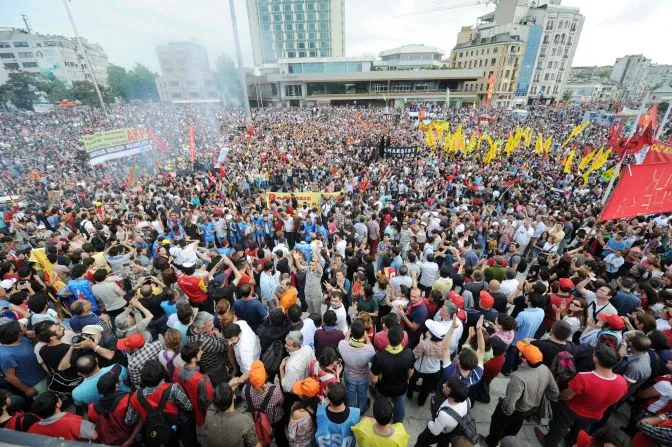
Photo: Istanbul minibus taxi drivers protest workers gathering street Turkey, via media.cnn.com
Every political coalition has a load-bearing wall. Knock it out and the whole structure gets wobbly fast. For Erdoğan, that wall has always been Turkey's urban and peri-urban working class — the guys driving minibuses through Istanbul's choking traffic, the delivery riders weaving between cars on underpowered scooters, the cab drivers working double shifts to cover rent that's doubled in three years. These were his people. Culturally conservative, religiously observant, suspicious of the secular elite, and grateful — or at least they used to be grateful — for the economic growth that defined Erdoğan's early years in power.
That gratitude is curdling. And if you want to understand where Turkish politics is actually headed, you'd do a lot better listening to what's being said at Istanbul's taxi stands than reading the polling aggregates.
When the Base Stops Being the Base
Let's be specific about what's happening, because vague talk of "working-class discontent" doesn't capture the texture of it.
Turkey's inflation crisis hasn't been some abstract macroeconomic phenomenon. It has been viscerally, personally devastating for people whose incomes are denominated in lira and whose costs — fuel, vehicle maintenance, food, housing — have exploded. A cab driver who bought his taxi medallion on credit a few years ago is now servicing that debt with a currency worth a fraction of what it was when he signed the loan. A delivery rider who thought he was building toward something is discovering that the math simply no longer works, no matter how many hours he logs.
What makes this politically significant isn't just the economic pain itself. It's the dawning recognition among these workers that the government they supported isn't going to fix it. Worse, many of them are starting to connect the dots between Erdoğan's unorthodox economic management — his stubborn resistance to raising interest rates in defiance of basic monetary logic, his dismissal of credentialed economists as enemies of the people — and their own deteriorating circumstances.
That's a cognitive shift that's genuinely hard to reverse.
Organizing in the Shadows
Formal labor organizing in Turkey operates under serious constraints. The government has a long track record of viewing independent union activity with suspicion, and workers in the gig economy face the additional structural problem of being classified as independent contractors rather than employees — which means they lack even the limited protections that Turkey's labor law extends to formal workers.
But informal organizing is a different story. WhatsApp groups connecting drivers across districts. Impromptu work stoppages coordinated through social media. Collective pressure campaigns targeting platform companies over commission rates and algorithmic management. None of this looks like a traditional labor movement, and it wouldn't survive a comparison to, say, the UAW's organizing infrastructure. But it's real, it's growing, and it represents a form of working-class political consciousness that Erdoğan's coalition-builders haven't figured out how to absorb or neutralize.
The minibus operators — the dolmuş drivers who form a kind of informal transit backbone in Turkish cities — have been particularly active. Their grievances are specific and concrete: fuel costs, route regulations, competition from app-based services that operate with lower overhead and less regulatory burden. But the political valence of those grievances is shifting. Complaints that used to stop at "the system is unfair" are increasingly extending to "and the people running the system don't care about us."
That second part is the dangerous one for Erdoğan.
Why Washington Should Pay Attention
American foreign policy types tend to analyze Turkey through a fairly narrow lens: NATO commitments, the S-400 purchase, Kurdish policy, the Eastern Mediterranean. These are real issues and they matter. But they systematically miss the domestic political dynamics that will ultimately determine what kind of country Turkey is and, by extension, what kind of ally or adversary it will be.
A Turkey where Erdoğan's working-class base is fragmenting is a Turkey that becomes harder to predict. If economic pain drives enough of those voters toward opposition parties — or, perhaps more likely, toward disengagement and abstention — it changes the electoral math in ways that could produce either a genuine political transition or, if Erdoğan feels sufficiently threatened, a significant escalation of authoritarian consolidation.
Both outcomes have major implications for the US. A democratic transition in Turkey would be enormously positive for the NATO alliance and for regional stability, but it would come with its own turbulence. A more cornered and authoritarian Erdoğan is a less predictable partner on everything from Ukraine to the Eastern Mediterranean.
Washington needs analysts who understand that the signal isn't coming from the presidential palace. It's coming from the dispatch radio.
The Taksici as Political Canary
This site exists because there's a kind of political intelligence that you can only get from street-level sources — from the guy who's been driving the same routes for fifteen years and has watched the neighborhood change, the prices change, the attitudes of his passengers change. Istanbul's transport workers have always been an unusually sensitive barometer of working-class sentiment, partly because of the nature of their work (constant contact with people from every income level and political persuasion) and partly because their economic position makes them acutely sensitive to the policy choices that filter down from Ankara.
Right now, that barometer is reading stormy. The anger is real, it's specific, and it's directed upward in ways that would have seemed unlikely even three years ago. Whether it translates into durable political change depends on a dozen variables — opposition party competence, electoral integrity, the trajectory of the economy — that nobody can predict with confidence.
But the first step toward understanding what's coming is taking seriously the voices of people who've been written off as permanently loyal. They're telling us something important. It would be a mistake to keep not listening.